Artificial neural network
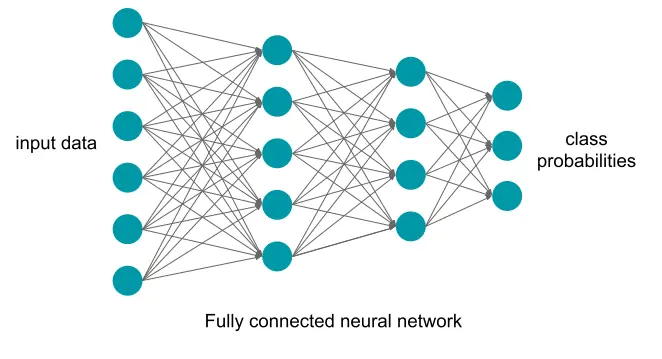
An artificial neural network (ANN) is a computational model inspired by the structure and function of biological nervous systems. At its core, a neural network consists of interconnected processing units called artificial neurons or nodes. These nodes are organized into structural layers: an input layer that receives raw data, one or more hidden layers that process intermediate features, and an output layer that generates final predictions or classifications. Data moves through connections weighted by numerical parameters. During training, the network iteratively adjusts these weights using optimization algorithms to minimize error and accurately model complex, non-linear relationships in data.
Neural Network Architecture Overview Neural network architecture refers to the structural arrangement of layers, node connections, and data flow mechanisms within a model. Different architectures are specialized for distinct data structures and task requirements.
Multilayer Perceptron (MLP) The Multilayer Perceptron is a foundational feedforward architecture where connections flow strictly in one direction from input to output. Every node in a given layer connects to every node in the subsequent layer. MLPs are primarily utilized for structured tabular data, general regression, and basic classification tasks.
Convolutional Neural Network (CNN) Convolutional Neural Networks are engineered for spatial and grid-structured data, such as images. CNNs utilize specialized convolutional layers that slide mathematical filters across inputs to extract local features—such as edges and textures—followed by pooling layers that reduce spatial dimensionality.
Recurrent Neural Network (RNN) Recurrent Neural Networks are designed to handle sequential data, such as time-series metrics or natural language. Unlike feedforward systems, RNNs incorporate internal feedback loops that maintain a temporal memory, allowing information from prior sequence steps to influence current predictions.
Transformer Transformers represent the modern standard for sequence modeling and large-scale language applications. Relying on self-attention mechanisms rather than sequential processing, Transformers evaluate relationships across all tokens in an input sequence simultaneously, enabling efficient parallelization and superior handling of long-range dependencies.