From Software Engineering to Language and Human Society
Abstract
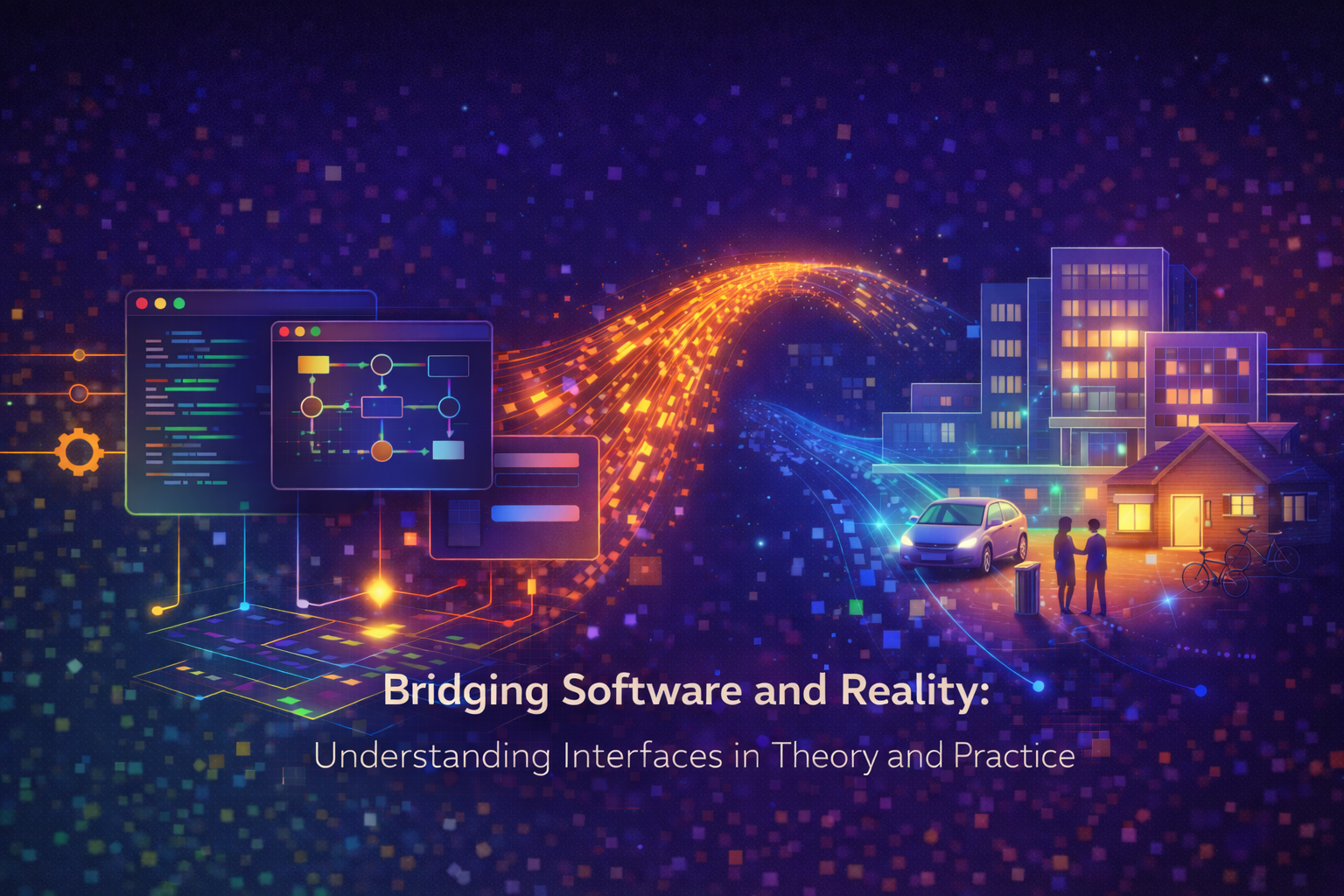
The concept of an interface is most commonly associated with software engineering; however, its underlying principle extends far beyond technology. An interface may be defined as a structured mediating layer that reduces complexity, enables communication, and facilitates smoother interaction between distinct entities. At its essence, an interface exists to bridge separation—whether that separation is technical, social, cognitive, or conceptual.
Interface in Software Engineering
In software systems, internal mechanisms are often complex and impractical for direct interaction. Core logic, memory management, and low-level execution processes are not designed for human accessibility. Therefore, interfaces are intentionally constructed to expose only necessary functionalities while concealing internal complexity.
This abstraction enables developers and users to interact with systems in a predictable and controlled manner. Without interfaces, engagement would require direct manipulation of low-level operations, significantly increasing cognitive load and reducing efficiency. In this context, the interface acts as a stability layer between complexity and usability.
Social Structures as Interfaces
The same structural pattern appears in social systems. In hierarchical societies, direct communication between levels of authority is often restricted or inefficient. Historical monarchies provide a clear illustration. A king could not realistically engage directly with every citizen. As a result, structured roles such as ministers, advisors, and representatives emerged.
These individuals functioned as intermediaries, transferring information, requests, and decisions between the ruler and the public. They formed a human interface layer that maintained order, filtered communication, and preserved hierarchy. The king represented the core authority, while ministers operated as the communicative abstraction layer.
Programming Languages as Cognitive Interfaces
A comparable phenomenon can be observed in computing history. Machines fundamentally operate through binary instructions and low-level assembly code. Direct interaction with such representations is inefficient and unnatural for human cognition. Consequently, higher-level programming languages were developed.
Languages such as Python, Java, and C++ serve as interfaces between human reasoning and machine execution. They translate human-readable logic into machine-processable instructions. The computer does not inherently understand Python; rather, Python operates as an interpretive layer that converts structured human intent into executable form.
Thus, programming languages reduce the semantic gap between human abstraction and computational precision.
Mediated Systems Beyond Technology
Beyond software and governance, the interface concept emerges in broader human systems. In certain religious traditions, communication with the divine is mediated through prophets, saints, or spiritual figures. Independent of personal belief, the structural principle remains consistent: when direct access to a central authority is perceived as distant, complex, or inaccessible, an intermediary layer forms to facilitate interaction.
This recurring architectural pattern demonstrates that interfaces are not merely technical constructs; they are systemic responses to complexity and separation.
Language as the Ultimate Interface
The most profound manifestation of the interface concept is language itself. Language is not thought; rather, it is the medium through which thought becomes expressible. The human brain does not fundamentally operate in words or alphabets. It processes experiences, perceptions, abstractions, and conceptual structures.
Words are symbolic mappings assigned to internal representations.
Consider the concept of a table. In English it is referred to as “table,” in German as “Tisch,” and in Persian as “miz.” Although the linguistic symbols differ, the underlying conceptual object remains constant. The same principle applies to color perception. The word “blue” varies across languages, yet the perceptual experience associated with it is stable.
Therefore, language functions as an interface that translates internal conceptual states into shared communicative symbols. It enables the transfer of meaning from one cognitive system to another.
A Generalized Structural Pattern
From a higher-level analytical perspective, interfaces consistently emerge wherever complexity, hierarchy, or structural distance exists. They perform several essential functions:
- Reduction of complexity
- Abstraction of internal mechanisms
- Facilitation of controlled interaction
- Translation between incompatible systems
- Preservation of structural boundaries
Whether in software architecture, political systems, computational linguistics, or human cognition, the interface represents a universal mechanism of mediation.
Conclusion
The interface should not be viewed solely as a technical artifact within programming disciplines. Rather, it is a foundational organizational principle embedded across human systems. Language stands as the ultimate interface, bridging internal cognition and external communication, transforming private conceptual realities into collectively understood structures.
In this broader sense, the study of interfaces is not only a technical inquiry but also a philosophical investigation into how complexity becomes accessible and how separation becomes connection.